The Biology of Free Will
Molecular biologists have assured neuroscientists for years that the molecular structures involved in neurons are too large to be affected significantly by quantum phenomena.
They know that while most biological structures are remarkably stable, and thus adequately determined, quantum effects drive the mutations that provide variation in the gene pool. So our question is how the typical structures of the brain have evolved to deal with microscopic, atomic level, noise. Can they ignore it because they are adequately determined large objects, or might they have remained sensitive to the noise?
We can expect that if quantum noise, or even ordinary thermal noise, offered beneficial advantages, there would have been evolutionary pressure to take advantage of noise.
Proof that our sensory organs have evolved until they are working at or near quantum limits is evidenced by the eye's ability to detect a single photon (a quantum of light energy), and the nose's ability to smell a single molecule.
Biology provides many examples of ergodic creative processes following a trial and error model. They harness chance as a possibility generator, followed by an adequately determined selection mechanism with implicit information-value criteria.
Darwinian evolution is the first and greatest example of a two-stage creative process, random variation followed by critical selection, but we will consider briefly two other such processes. Both are analogous to our two-stage
Cogito model for the mind. One is at the heart of the immune system, the other provides quality control in protein/enzyme factories.
Creativity in the Immune System
Consider the great problem faced by the immune system. It stands by ready to develop antibodies to attack an invading antigen at any moment, with no advance knowledge of what the antigen may be. In information terms, it needs to discover some part of the antigen that is unique. Its method is not unlike
Poincaré's two-stage method of solving a mathematical problem. First put together lots of random combinations, then subject them to tests.
Biological information is stored in the the "genetic code," the sequence of genes along a chromosome in our DNA. "Sequencing" the DNA refers to establishing the exact arrangement of nucleotides that code for specific proteins/enzymes. All the advances in molecular genetics are based on this sequencing ability.
The white blood cells have evolved a powerful strategy to discover unique information in the antigen. What they have done is evolve a "re-sequencing" capability. Using the same gene splicing techniques that biologists have now developed to insert characteristics from one organism into another, the white blood cells have a very-high-speed process that shuffles genes around at random. They cut genes out of one location and splice them at random in other locations. This combinatorial diversity provides a variation in the gene pool like the Darwinian mutations that drive species evolution.
But the marvelous immune system gets even more random. It has a lower-level diversity generator that randomly scrambles the individual nucleotides at the junctions between genes. The splicing of genes is randomly done with errors that add or subtract nucleotides, creating what is called junctional diversity.
Rapid Eye Motions
Free Flight and Crowd Navigation
"Free flight" in birds might resemble the way humans navigate crowds by random small variations in their walking paths followed by rapid feedback corrections to avoid bumping others?
Enzyme Chaperones - An Error Detection and Correction System
Errors in protein synthesis are arguably quantal. If errors prevent proper folding, the chaperone functions as an information error detection and correction system. If it succeeds in helping the protein to fold, the protein is released, otherwise destroyed.
Neurotransmitter Release
Since information flows across the synapses, randomness of release times for transmitter quanta may be a source of information noise in memory storage and recall. [Neurotransmitter "quanta" are of course huge compared to atomic-level quantum processes - maybe thousands of molecules).
Bacterial chemotaxis
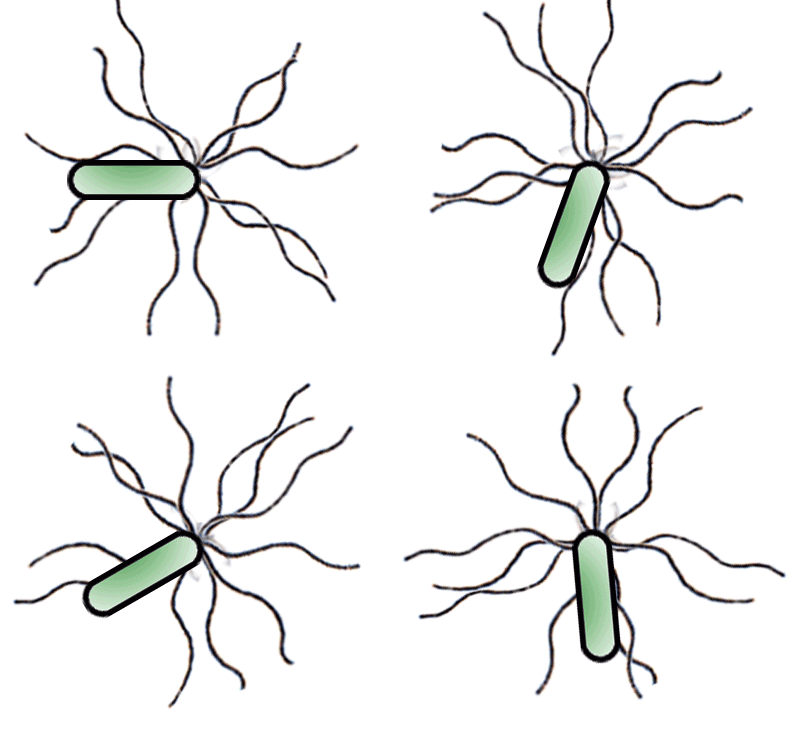
The smallest organisms are equipped with sensors and motion capability that let them make two-stage decisions about which way to go. They must move in the direction of nutrients and away from toxic chemicals. They do this with tiny flagella that rotate in two directions. Flagella rotating clockwise cause the bacterium to tumble and face random new directions.
When the bacterium moves, receptors on the bacterium surface detect gradients of chemicals.
When the gradient indicates “food ahead” or “danger behind” the bacterium maintains the flagella rotation direction, which keeps the bacterium moving straight ahead.
Single photons can be seen and a single molecule can be smelled
For Teachers
To hide this material, click on the Normal link.
For Scholars
To hide this material, click on the Teacher or Normal link.
Notes
Baylor, D. A., T. D. Lamb, and K.-W Yau, "Responses of Retinal Rods to Single Photons,"
Journal of Physiology vol. 288, (1979), pp. 613-634.
Normal |
Teacher |
Scholar

 |
|